

Parser Configuration Settings
Dieser Inhalt ist noch nicht in deiner Sprache verfügbar.
In Crowdin übersetzenBy default, Crowdin uses a predefined set of import and export parameters for each supported file format.
The Parser configuration feature lets you change the default import and export behavior predefined for file formats supported by Crowdin. Parser configuration in a specific project is applied only to files stored in this project.
You can set the parser configuration for all files of a certain format or single files. Once you save the parser configuration for some file format, you can upload source files to your project, and Crowdin will apply your settings accordingly.
You can configure import and export behavior for the following formats: Java Properties, Generic XML, DITA, AsciiDoc, Plain text, MadCap Flare, HTML, Office documents, Adobe FrameMaker, Adobe InDesign, Markdown, and MediaWiki.
Some parameters are common to all formats, while others are format-specific. In the table below, you can see the available parser parameters and formats they could be configured for.
| Parameter | Beschreibung | Format |
|---|---|---|
| Inhaltssegmentierung | Beim Import wird der Inhalt der Quelldatei mithilfe vordefinierter Segmentierungsregeln (SRX 2.0) in kürzere Textsegmente aufgeteilt. | Generisches XML, DITA, AsciiDoc, MadCap Flare, HTML, Office-Dokumente, Adobe FrameMaker, Adobe InDesign, Markdown |
| Benutzerdefinierte Segmentierungsregeln | Definiert deine eigenen Segmentierungsregeln. Erfahre mehr über Benutzerdefinierte Segmentierung. | Generisches XML, DITA, AsciiDoc, Reine Textdatei, MadCap Flare, HTML, Office-Dokumente, Adobe FrameMaker, Adobe InDesign, Markdown, MediaWiki |
| Ausgeschlossene Elemente | Definiert eine Liste von CSS-Stil-Selektoren für Elemente, die nicht zur Übersetzung zur Verfügung stehen sollen (z. B. code, pre > code, .code-block). Trifft nur auf Block-Elemente zu. Inline-Elemente werden ignoriert. | HTML, HTML mit Front Matter |
| Ausgeschlossene Front-Matter-Elemente | Definiert eine Liste von Front-Matter-Elementen, die nicht zur Übersetzung zur Verfügung stehen sollen (z. B. keywords, “internal.description”, tags). Die Pfadelemente sollten durch einen Punkt getrennt werden. Schlüssel, die einen Punkt enthalten, müssen in Anführungszeichen eingeschlossen werden. | HTML with Front Matter, MDX |
| Code-Blöcke ausschließen | Definiert, ob Code-Blöcke importiert werden sollen. Trifft nur auf Code-Blöcke zu. Inline-Elemente mit Code werden ignoriert. | MDX |
| Inhalt übersetzen | Texte innerhalb der Tags stehen zur Übersetzung zur Verfügung. | Generisches XML |
| Attribute übersetzen | Tag-Attribute stehen zur Übersetzung zur Verfügung. | Generisches XML |
| Übersetzbare Elemente | Definiert die spezifischen Knoten und Attribute, die für die Übersetzung zur Verfügung stehen sollen. | Generisches XML |
| Einfaches Anführungszeichen maskieren | Definiert das Verhalten bezüglich der Maskierung von einfachen Anführungszeichen in exportierten Übersetzungen.
| Java Properties |
| Sonderzeichen maskieren | Alle Sonderzeichen (z. B., | Java Properties |
| Tags aggressiv bereinigen | Zusätzliche Formatierungs-Tags zur Textabstandsregelung werden beim Import entfernt. Nützlich beim Übersetzen von Office-Dokumenten, die aus anderen Formaten (z. B. PDF etc.) konvertiert wurden und bei denen durch die Konvertierung viele unnötige Formatierungs-Tags entstanden sind. | Office-Dokumente |
| Hyperlink-URLs übersetzen | Hyperlink-URLs stehen zur Übersetzung zur Verfügung. | Office-Dokumente |
| Versteckten Text übersetzen | Versteckter Text steht zur Übersetzung zur Verfügung. | Office-Dokumente |
| Versteckte Zeilen und Spalten übersetzen | Versteckte Zeilen und Spalten stehen zur Übersetzung zur Verfügung. | Office-Dokumente |
| Versteckte Folien importieren | Versteckte Folien stehen zur Übersetzung zur Verfügung. | Office-Dokumente |
| Notizen importieren | Die Foliennotizen stehen zur Übersetzung zur Verfügung. | Office-Dokumente |
Parser Configuration for All Project Files of a Specific Format
Section titled “Parser Configuration for All Project Files of a Specific Format”To set the preferred parser configuration for all files of a specific format, follow these steps:
- Open your project and go to Settings > Parser configuration.
- Choose the needed file format and click Edit.
- Set the preferred settings.
- Click Save.
Alternatively, for formats with configurable parser settings, you can open the same settings from the Create bundle or Edit bundle dialog by clicking next to the target format.
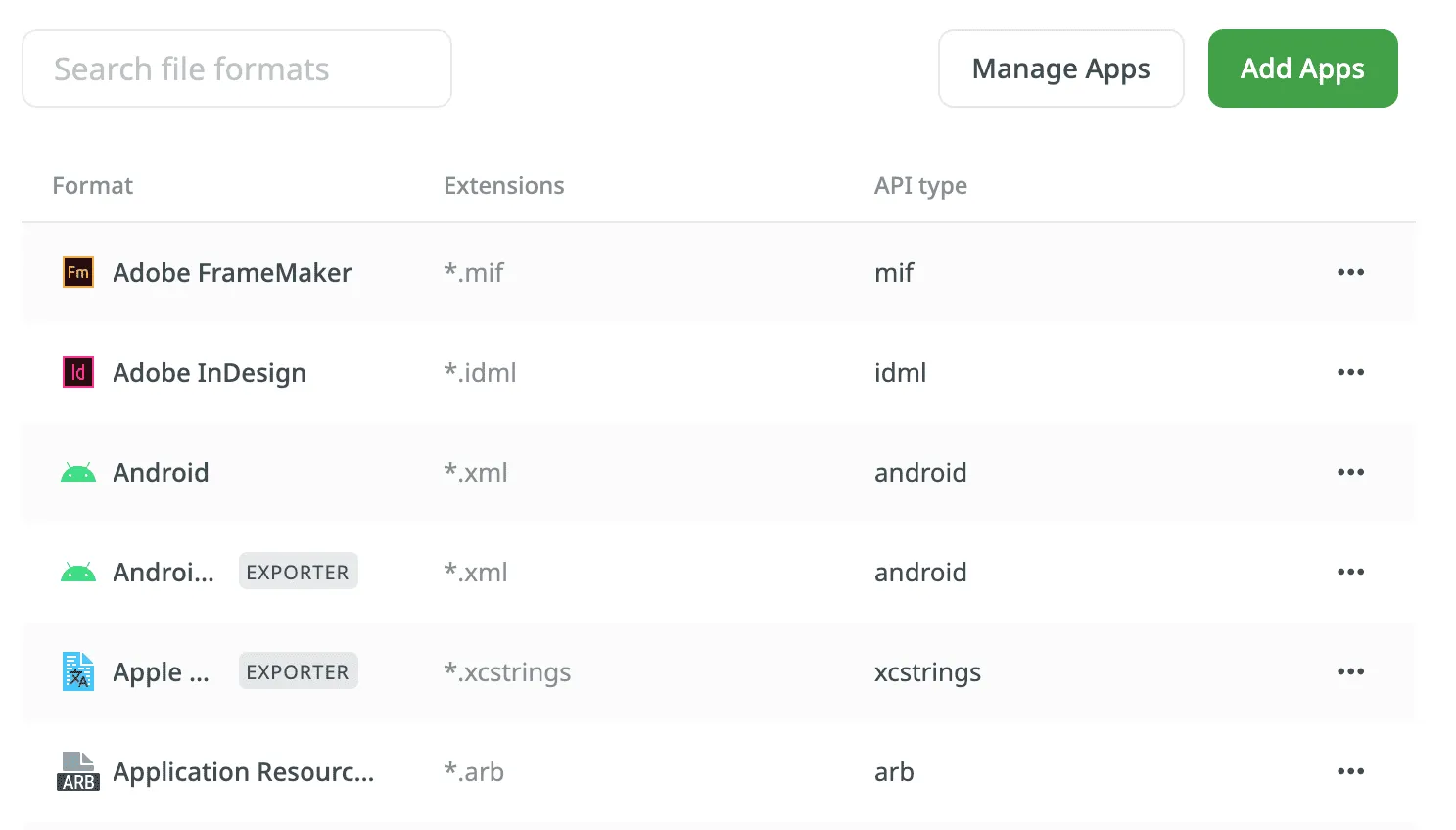
To add a new file format, click Add Apps and install the required format.
In some cases, you might need to set the parser configuration not for all files of some file format but just for a single file. To set the parser configuration for a single file, follow these steps:
- Open your project and go to Sources > Files.
- Double-click on the needed file.
- In the appeared dialog, switch to the Parser configuration tab.
- Set the preferred settings.
- Click Save.
Once you save the file parser configuration, Crowdin will reimport this file and apply your settings.
Read more about file management in Crowdin.
Sometimes, you might work with files that contain strings in a different format. A common example is a JSON file where some string values contain HTML content. The standard parser configuration isn’t designed for these nested or cascading scenarios.
To properly process such files, you need to implement a custom Crowdin App that uses the File Post-Import Processing Module. This method, sometimes referred to as cascade processing, allows your app to intercept imported strings and instruct Crowdin to re-process specific ones using a different parser. For instance, you can tell Crowdin to parse a string from a JSON file as HTML, ensuring that HTML tags are correctly handled and not exposed to translators as plain text.
To handle files with nested content, you can install the Cascade Importer from the Crowdin Store or, for more custom scenarios, build your own.